
FORTIS: Fortified Island. Militarisation, Conflict and Communities on Iron Age Bornholm
FORTIS focuses on Bornholm’s prehistoric fortifications. The project aims to establish a detailed chronology of the forts and to understand them within a broader societal context. It is a close collaboration between the University of Copenhagen, the National Museum of Denmark, and Bornholm Museum.
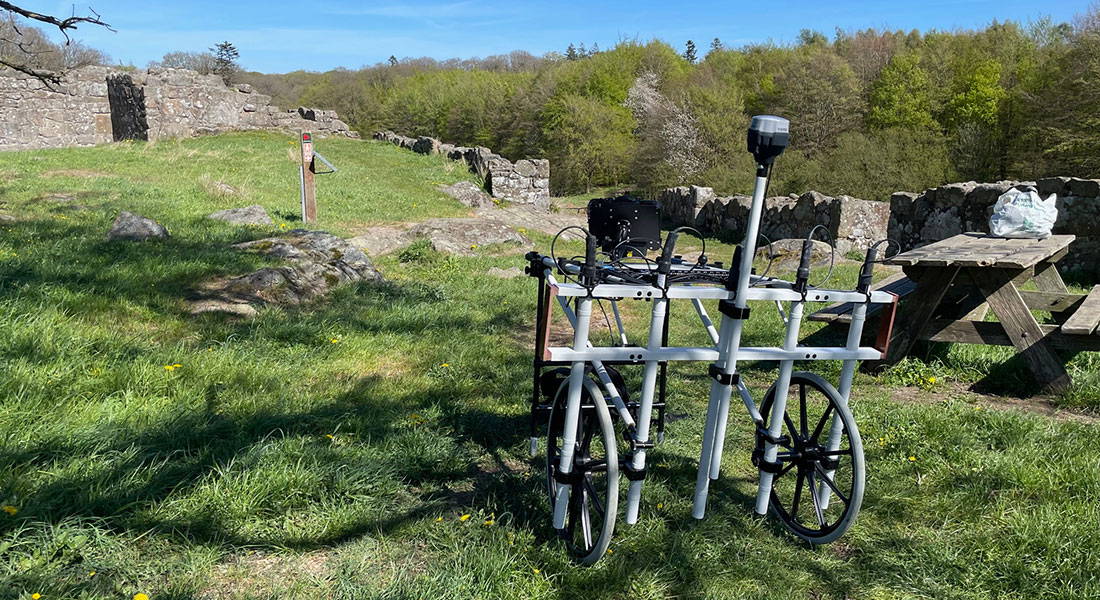
By focusing on Bornholm’s prehistoric fortifications as keys to the island’s societal development, the FORTIS project aims to understand the island’s role in the Baltic Sea. Constructing defensive structures required substantial resources and may reflect a need for security, but could also have served other purposes.
The project aims to gain deeper insight into the structure and dating of each fort, and to relate them to the broader organization of island society and to the Baltic region, Scandinavia, and Northern Europe. This is achieved through mapping, surveying, and excavations of the individual forts.
In addition, the organization of ordinary settlements and agricultural landscapes is described and analyzed in a PhD project, and the island’s weapon graves are mapped in time and space.
Our knowledge of prehistoric fortifications on Bornholm and in the rest of Denmark is generally limited. The project therefore aims to fill a gap in our overall understanding of conflict and society in the Baltic region during the Iron Age, partly by comparing Bornholm with the better-studied Swedish island of Öland. We know that these fort sites were used across many periods, including the Stone Age, Bronze Age, and Middle Ages, so the project operates with a long-term perspective.
FORTIS will also contribute to a broader understanding of how militarization shapes societies. Through its long-term perspective, the project highlights Bornholm’s unique history and security conditions. In the past, as today, Bornholm held both a central and vulnerable position in the Baltic Sea. During the Iron Age, the island was a natural hub for trade and connections, but its advantageous location also made it vulnerable to raids and power struggles. A similar duality can be seen today, where Bornholm is both a popular tourist destination and an area of military interest. The project will also generate new knowledge about societal development in the Iron Age, which is crucial for understanding early state formation and the establishment of royal power in southern Scandinavia.
Researchers
Internal
| Name | Title | Phone | |
|---|---|---|---|
| Albris, Sofie Laurine | Assistant Professor - Tenure Track | +4535321034 | |
| Pihl, Anders | PhD Student | +4535326930 |
External
| Name | Title |
|---|---|
| Jessen, Mads Dengsø | National Museum of Denmark |
| Stamnes, Arne A. | Norwegian Institute for Cultural Heritage Research |
| Jensen, Xenia Pauli | Moesgaard |
Funding

Independent Research Fund Denmark, Sapere Aude Research Leader
Project period: 2023-2027