
Osseous industries in southern Scandinavia before and after Neolithisation (5400–2600 BC): Traditions, ruptures, & interactions
Friday lecture by Solveig Chaudesaigues-Clausen, PhD student (University of Bergen) and archaeologist (Museum West Zealand).
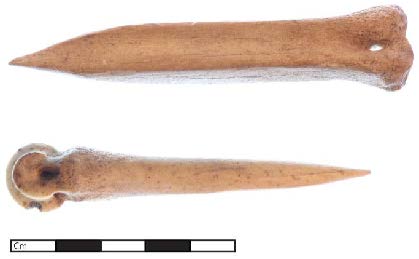
Based on aDNA and material culture, the last decade of research into Neolitihisation in southern Scandinavia suggests that local hunter-gatherers continued living by lakeshores and coastal zones after migrants from western-central Europe introduced farming. However, objects made from worked bone, antler, and teeth (osseous industries), which form a major component of the material culture of these groups, have rarely been incorporated into these discussions.
This talk presents the threefold results of a recent PhD thesis. First, I characterise the osseous industries of the Late Mesolithic Ertebølle (5400–4000 BC) and Neolithic Funnel Beaker (4000–2800/2600 BC) culture, focusing on typology, raw material selection, technology, and temporal/geographical variations. Second, I examine whether certain hunter-gatherer osseous traditions persisted during the Early Neolithic, became hybridised, or disappeared. Finally, I investigate the origins of Funnel Beaker osseous industries, asking if they were shaped by local Ertebølle practices, continued western-central European traditions, or resulted from more complex processes.
No registration required, everyone is welcome. Questions? Contact Henriette Lyngstrøm at lyngst@hum.ku.dk.
About the series
See all Friday lectures in the series
-
6 February 2026: En verden uden billeder: Hvorfor holdt neolitiske samfund op med at lave figuriner? by Valeska Becker (in Danish)
-
13 February 2026: Osseous industries in southern Scandinavia before and after Neolithisation (5400–2600 BC): Traditions, ruptures, & interactions by Solveig Chaudesaigues-Clausen
-
20 February 2026: Penge og/eller mønter by Helle Horsnæs (in Danish)
-
27 February 2026: Theoretical concepts and an easy practical tool for working with prehistoric wealth and inequality by Mikkel Nørtoft
-
6 March 2026: Mønter – arkæologens bedste ven by Gitte Ingvardson (in Danish)
-
13 March 2026: Vi ta'r rygmærket på – vi bliver arkæologer. Men hvordan? by Henriette Lyngstrøm and more (in Danish)
-
20 March 2026: Den samfundsmæssige udvikling i Jylland i førromersk jernalder (500-1 f.v.t.) by Per Ole Rindel (in Danish)
-
27 March 2026: Frisurer fra jernalderen by Charlotte Rimstad (in Danish)
-
10 April 2026: FORTIS - et projekt om jernalderens befæstninger på Bornholm by Laurine Albris (in Danish)
-
17 April 2026: Moselig – mænd, kvinder og unisex by Ulla Mannering (in Danish)
-
24 April 2026: 'Making it’: Exploring Roman coins and mosaics through practical experiments by Fran Lam-March and Will Wootton
-
1 May 2026: All quiet on the Western front? The Late Bronze Age and Early Iron Age of Greece as seen from its Western mainland by Joos Melander
-
8 May 2026: Haithabu som et nationalt projekt by Carsten Jahnke (in Danish)
Map of South Campus
View directions.
View on map of the Faculty of Humanities - South Campus.
View map of South Campus (pdf).