
'Making it’: Exploring Roman coins and mosaics through practical experiments
Friday lecture by Fran Lam-March, PhD student in classical archaeology, King’s College London, and Will Wootton, Professor in classical archaeology, King’s College London.
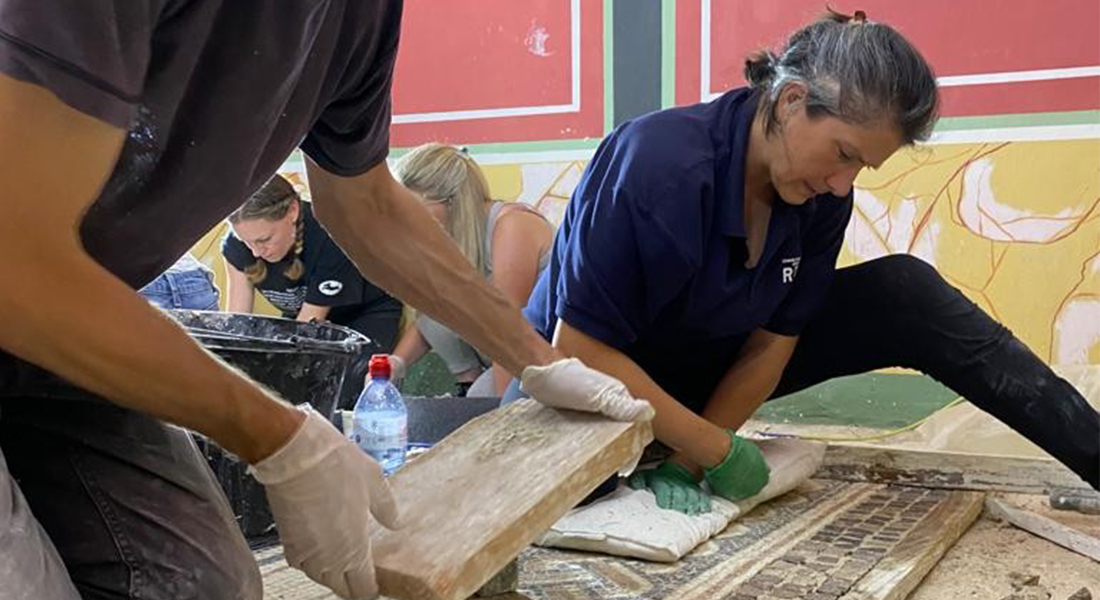
We are accustomed to seeing the many coins and mosaics from across the Roman empire but rarely do we spend much time thinking about how they were made. Copper-alloy coins are by nature incredibly difficult and complex to strike. The secretive nature of coin minting makes recreating the production process difficult. Similarly, mosaic is a multi-media craft with complex techniques applied in sequence and over time. Traditions of mosaic making, although less intentionally secretive, were rarely written down instead being passed between individual practitioners and groups.
This talk combines two strands of experimental research based on extant tools and materials along with the archaeological evidence. It showcases attempts to recreate the emperor's portrait on bronze coinage and produce a domestic pavement for a replica Roman villa. Using experimental archaeology and a comparative approach, we hope to shed light on new aspects of the production processes involved while also understanding the critical limitations of this method.
No registration required, everyone is welcome. Questions? Contact Henriette Lyngstrøm at lyngst@hum.ku.dk.
About the series
See all Friday lectures in the series
-
6 February 2026: En verden uden billeder: Hvorfor holdt neolitiske samfund op med at lave figuriner? by Valeska Becker (in Danish)
-
13 February 2026: Osseous industries in southern Scandinavia before and after Neolithisation (5400–2600 BC): Traditions, ruptures, & interactions by Solveig Chaudesaigues-Clausen
-
20 February 2026: Penge og/eller mønter by Helle Horsnæs (in Danish)
-
27 February 2026: Theoretical concepts and an easy practical tool for working with prehistoric wealth and inequality by Mikkel Nørtoft
-
6 March 2026: Mønter – arkæologens bedste ven by Gitte Ingvardson (in Danish)
-
13 March 2026: Vi ta'r rygmærket på – vi bliver arkæologer. Men hvordan? by Henriette Lyngstrøm and more (in Danish)
-
20 March 2026: Den samfundsmæssige udvikling i Jylland i førromersk jernalder (500-1 f.v.t.) by Per Ole Rindel (in Danish)
-
27 March 2026: Frisurer fra jernalderen by Charlotte Rimstad (in Danish)
-
10 April 2026: FORTIS - et projekt om jernalderens befæstninger på Bornholm by Laurine Albris (in Danish)
-
17 April 2026: Moselig – mænd, kvinder og unisex by Ulla Mannering (in Danish)
-
24 April 2026: 'Making it’: Exploring Roman coins and mosaics through practical experiments by Fran Lam-March and Will Wootton
-
1 May 2026: All quiet on the Western front? The Late Bronze Age and Early Iron Age of Greece as seen from its Western mainland by Joos Melander
-
8 May 2026: Haithabu som et nationalt projekt by Carsten Jahnke (in Danish)
Map of South Campus
View directions.
View on map of the Faculty of Humanities - South Campus.
View map of South Campus (pdf).